
Combinatorics
4 chapters
Imagine you have a box of colored balls and you're deciding how to select or arrange them in various ways. This process of deciding, counting, and organizing is the heart of combinatorics, one of the most interesting branches of mathematics. Combinatorics deals with counting, arranging, and combining objects according to specific rules. This discipline is fundamental to solving problems involving discrete structures and plays a key role in graph theory, optimization, computer science, and statistical probability theory. It allows mathematicians and scientists to develop methods for efficient counting without needing to list every single case.
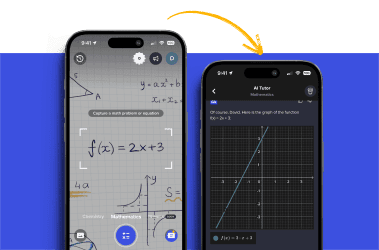


Take a picture of your assignment and use AI tutor.
The Fundamental Counting Principle
2 videos
What is Combinatorics?

The Rule of Product
Permutations
3 videos
What Are Permutations?
Permutations with Repetition
Permutations without Repetition
Variations in Combinatorics
What Are Variations?
Variations with Repetition
Combinations
1 video
What are Combinations?
THE IMPORTANCE OF COMBINATORICS IN MATHEMATICS
Combinatorics helps us answer questions like, "In how many different ways can we distribute prizes among contestants?" or "How many different passwords can be created using only four digits?" The answers to these questions are not always obvious, and combinatorics provides the tools to find them.
CORE CONCEPTS
In combinatorics, we encounter concepts such as permutations and combinations.
PERMUTATIONS (ORDER MATTERS)
Permutations are the different ways we can arrange a group of objects where the order is important. For example, if we have three books and want to know how many ways we can stack them on a shelf, we use permutations.
COMBINATIONS (ORDER DOES NOT MATTER)
We use combinations when the order is not important. For instance, imagine choosing three friends from a group of ten for a project. In this case, we don't care about the order in which we select them, only who is chosen.
APPLICATIONS OF COMBINATORICS
Combinatorics has a wide range of applications in numerous fields:
- GRAPH THEORY: It uses combinatorial concepts to study networks and their properties, such as paths, cycles, and connectivity.
- COMPUTER SCIENCE: Combinatorial methods are fundamental for algorithms, data structures, cryptography, and the analysis of algorithms.
- OPTIMIZATION: Solving problems that involve finding the best solution from a finite set of possibilities often requires combinatorial approaches.
- STATISTICS AND PROBABILITY THEORY: Combinatorics enables the calculation of probabilities for complex events and the analysis of sampling.
CONCLUSION
Combinatorics is crucial for understanding and manipulating discrete mathematical structures, offering deeper insights into the organization and analysis of complex systems. Its versatility and practical utility in mathematics, science, and engineering prove that its study is essential for advancement in these disciplines. Exploring combinatorics not only expands the boundaries of mathematical knowledge but also contributes to solving practical problems in technology, economics, and daily life.