
Derivatives
4 chapters
Derivatives express the rate of change of a function's value with respect to the change in its variable. They are used to study dynamic phenomena and are the foundation of differential calculus.
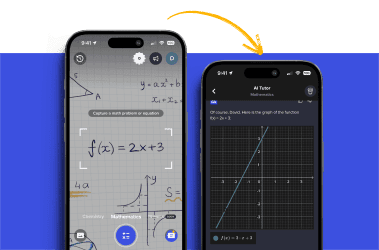


Take a picture of your assignment and use AI tutor.
Definition of the Derivative
8 videos
What is a Derivative?

Rules for Differentiation
Rules for Calculating the Derivative of a Function
Derivative by Definition 1
Derivative by Definition 2
Derivatives - Excercise 1
Derivative – Exercise 2
Derivative – Exercise 3
Stationary Points, Increasing/Decreasing Functions
2 videos
Accurate Graphing of Functions
Extrema of a Function 1
Slope of the Tangent and Normal Line
Equation of the Normal Line to a Curve at Point T
Equation of the Tangent Line at Point T
Derivatives of Other Elementary Functions
1 video
Derivative of a Function – Example 1
UNDERSTANDING DERIVATIVES: THE BASICS
The derivative is a central concept in differential calculus, a field of mathematics that deals with change. It represents a tool for analyzing the rates of change of functions. In this article, we will explore the definition of a derivative, the basic principles for its calculation, and the importance of derivatives in mathematical analysis.
DEFINITION OF A DERIVATIVE
The basic definition of the derivative of a function at a point is the limit of the ratio of the change in the function to the change in its independent variable, as the change in the variable approaches zero. If the function 'f' depends on the variable 'x', the derivative of 'f' at point 'x' is denoted as f′(x) or df/dx. This concept is the cornerstone of differential calculus and allows for the calculation of the slope of the tangent to the curve of a function at a given point.
RULES FOR CALCULATING DERIVATIVES
- CONSTANT RULE: This rule states that if a function does not change its value (i.e., it is a constant function), then its rate of change, measured by the derivative, is zero.
- POWER RULE: This tells us that when calculating the derivative of a function that is a power of a variable (e.g., xⁿ), the rate of change of this function increases or decreases based on the original power (specifically, the derivative of xⁿ is nxⁿ⁻¹).
- PRODUCT RULE: This explains that the rate of change of the product of two functions depends on the sum of the rates of change of each individual function, considered once acting independently and then in conjunction with the other function (specifically, (uv)' = u'v + uv').
APPLICABILITY
Derivatives are key in solving problems that involve change. Some of these applications include:
- TANGENT AND NORMAL LINES: The derivative of a function at a specific point represents the slope of the tangent to the graph of the function at that point.
- OPTIMIZATION PROBLEMS: By analyzing derivatives, we can determine the local extrema (maxima or minima) of functions, which is particularly useful when searching for maximum or minimum values in various applications.
- MOTION: In physics, derivatives allow for the calculation of an object's velocity and acceleration as functions of time.
CONCLUSION
Derivatives are a fundamental tool in mathematics that enable the understanding and analysis of change. Their applicative value ranges from pure mathematics to practical problems in science, engineering, and economics. Understanding derivatives enhances our ability to solve complex problems and contributes to the development of new technological innovations and scientific discoveries.