
Division
1 chapter
Division is a basic arithmetic operation that determines how many times one number is contained within another. It is expressed as a ÷ b = c (or a / b = c), where 'a' is the dividend, 'b' is the divisor, and 'c' is the quotient. Division is the inverse operation of multiplication and is not always possible within the set of natural numbers to yield another natural number, which leads to fractions or decimal numbers.
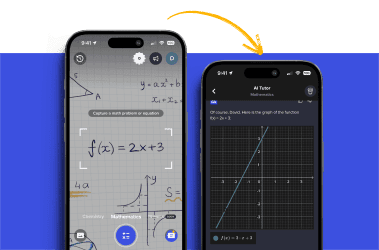


Take a picture of your assignment and use AI tutor.
Greatest Common Divisor & Least Common Multiple
1 video
GCD and LCM – Exercise

PROPERTIES OF DIVISION
Division has several characteristic properties:
- NOT COMMUTATIVE: In general, a ÷ b ≠ b ÷ a. For example, 8 ÷ 2 = 4, but 2 ÷ 8 ≠ 4.
- NOT ASSOCIATIVE: In general, (a ÷ b) ÷ c ≠ a ÷ (b ÷ c). For example, (16 ÷ 4) ÷ 2 = 2, while 16 ÷ (4 ÷ 2) = 8.
- DIVISION BY 1: Any number divided by 1 remains the same, i.e., a ÷ 1 = a.
- DIVISION BY 0 IS UNDEFINED: Since there is no number x for which x × 0 = a (unless a = 0, in which case 0/0 is indeterminate), division by 0 is not defined.
INTEGER DIVISION AND REMAINDER
When we divide two integers, the result is not always an integer. In integer division, only the whole part of the quotient is considered, and the remainder is recorded separately. For example: 17 ÷ 5 = 3 (whole part), with a remainder of 2.
This can be written as: 17 = 3 × 5 + 2.
Integer division is important in modular arithmetic and algorithms.
FRACTIONS AND DECIMAL NUMBERS
If the division of two numbers does not yield an integer, the quotient can be expressed as a fraction or in decimal form. For example: 7 ÷ 2 = 7/2 = 3.5.
A decimal quotient is often more precise for certain applications and is used in measurements, ratios, and computational operations.
SHARES AND RATIOS
Division allows for the calculation of shares and ratios. If we have a total quantity and divide it into equal parts, we get one share. For example, if 12 is divided among 4 people, each person gets 12 ÷ 4 = 3 units.
Ratios determine how two quantities compare. For example, a ratio of 8:2 means that the first quantity is four times larger than the second.
USES OF DIVISION
Division is key in solving equations, determining averages, and analyzing data. It is also used in more advanced mathematical concepts such as rational functions and differential calculus.
CONCLUSION
Division is a fundamental operation that allows for the breaking down of numbers into smaller parts. Its properties and rules are the basis for many mathematical calculations, from basic arithmetic to complex algebraic structures. Understanding division is crucial for the successful application of mathematics in various contexts.