
What is a Logarithmic Function?
Video explanation
Explanation
DEFINITION OF A LOGARITHMIC FUNCTION
A logarithmic function is the inverse of an exponential function. If y = b^x, where 'b' is a positive real number and not equal to 1, then the logarithmic function is defined as x = log_b(y). In other words, the logarithm tells us to what power we must raise the base 'b' to get 'y'.
TYPES OF LOGARITHMS
- NATURAL LOGARITHM (ln): Here, the base is Euler's number e ≈ 2.718. The natural logarithm is very important in calculus and is denoted as ln(x).
- COMMON LOGARITHM (log): The base of this logarithm is 10 and it is often used in engineering and science. It is denoted as log(x) or log_10(x).
PROPERTIES OF A LOGARITHMIC FUNCTION
- DOMAIN: A logarithmic function log_b(y) is defined only for positive real numbers 'y' (y > 0).
- INVERSE FUNCTION: The logarithmic function is the inverse of the exponential function.
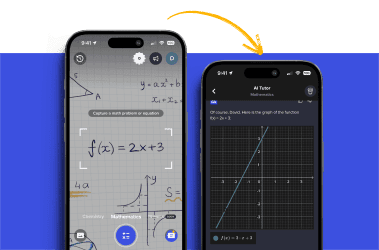


Take a picture of your assignment and use AI tutor.
- Function
- Linear Function
- Quadratic Function
- Inverse Function
- Power Function
- Exponential Function
- Logarithmic Function
- Exponential Equation