
Quadratic Function – Introduction
Video explanation
Explanation
QUADRATIC FUNCTION
DEFINITION
A quadratic function is a function of the form f(x) = ax² + bx + c, where a, b, and c are real numbers, and a ≠ 0. The function maps real numbers to real numbers.
MEANING OF THE COEFFICIENTS:
- LEADING COEFFICIENT (a):
- If a > 0, the graph (parabola) opens upwards.If a < 0, the graph opens downwards.The magnitude of |a| affects the width of the graph; the larger |a| is, the "narrower" the graph.
- LINEAR COEFFICIENT (b): The coefficient 'b' influences the position of the vertex of the parabola and its axis of symmetry.
- CONSTANT TERM (c): Represents the point where the graph intersects the y-axis, i.e., the point (0, c).
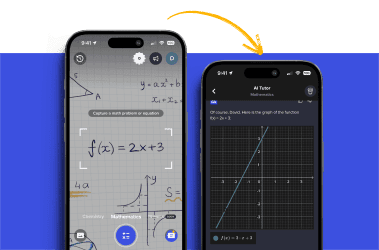


Take a picture of your assignment and use AI tutor.
- Function
- Linear Function
- Quadratic Function
- Inverse Function
- Power Function
- Exponential Function
- Logarithmic Function
- Exponential Equation