
Integrals
2 chapters
An integral is a fundamental concept in mathematics that represents the idea of accumulating or summing parts to calculate a whole. It is used to calculate areas under curves, volumes of solids, and for other purposes where it is necessary to sum infinitely small quantities.
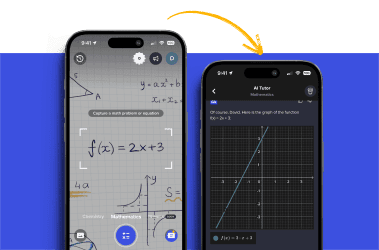


Take a picture of your assignment and use AI tutor.
Indefinite Integral
4 videos
What is an Integral?

General Formula for the Integral (Concept of Integration)
Integration of Rational Functions
Integration by Introduction of a New Variable 1 (Substitution Method)
Integration by Parts
2 videos
Integration by Parts – “per partes”
Integration by Parts 1
UNDERSTANDING INTEGRALS
Integrals are used to deal with infinitesimally small quantities and their summation to a final value that we are seeking. Integrals can be divided into two main categories: indefinite integrals and definite integrals.
WHAT IS AN INTEGRAL?
At its most basic level, an integral can be understood as a process by which we calculate the total value or "sum" of something that is changing. An integral allows us to calculate, for example, the total area under a curve on a graph or the total distance traveled if the speed is constantly changing.
MAIN TYPES OF INTEGRALS: INDEFINITE AND DEFINITE INTEGRALS
- INDEFINITE INTEGRAL: This is the basic form of an integral, which gives us a function (or a family of functions). The indefinite integral of a function tells us what the original function (antiderivative) must have been before it was differentiated. It is written as ∫f(x) dx, where f(x) is the function being integrated, and dx represents the variable of integration. The result includes a constant of integration, C.
- DEFINITE INTEGRAL: This type of integral gives us a numerical value and is used to calculate areas, volumes, or other quantities. It is written with an upper and lower limit, for example, ∫[a, b] f(x) dx (more commonly written as ∫ from a to b of f(x) dx), where 'a' and 'b' are the limits of the interval over which we integrate the function f(x).
METHODS FOR CALCULATING INTEGRALS
Various methods are used to calculate integrals:
- METHOD OF SUBSTITUTION (U-SUBSTITUTION): Allows simplification of integrals by changing variables.
- INTEGRATION BY PARTS: Used for functions that are a product of two other functions, allowing their integration by transforming them into an easier-to-solve form. (Formula: ∫u dv = uv - ∫v du).
- NUMERICAL METHODS: Such as the Trapezoidal Rule and Simpson's Rule, are used to approximate the values of definite integrals when an exact analytical solution cannot be found.
APPLICABILITY
Integrals have wide applicability:
- PHYSICS AND ENGINEERING: They are used to calculate work, energy, and other physical quantities related to changes in state or motion.
- ECONOMICS: Integrals allow for modeling and analysis of total costs, revenues, and other economic functions over time.
CONCLUSION
Their use ranges from solving practical problems to developing theoretical concepts in mathematics and science. The ability to calculate integrals opens doors to more advanced studies in analysis and also enables practical applications in many disciplines that are fundamental to our understanding of the world.