
Limits
1 chapter
Limits are a fundamental concept in mathematics that describe the value a function or sequence approaches as its variable approaches a certain point. They are used to understand the behavior of functions at extreme values or near points of discontinuity.
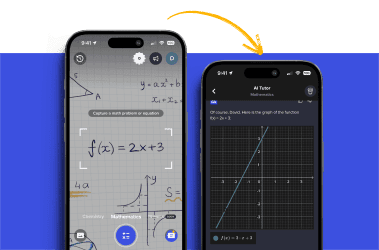


Take a picture of your assignment and use AI tutor.
Limit of a Function
1 video
What is a Limit?

INTRODUCTION AND DEFINITION OF LIMITS
Limits are a basic concept in mathematics that describe the behavior of functions as their input values approach a specific point. This concept is crucial for understanding infinitesimally small changes and forms the basis for differential and integral calculus. Limits allow students to formalize and analyze concepts such as infinity, continuity, and derivatives.
BASIC DEFINITION: The limit of a function at a point describes the value that the function approaches as its argument (or input value) approaches that specific point. Formally, this is expressed as the limit of the function f(x) as x approaches the value c.
UNDERSTANDING LIMITS
Limits are used to analyze various mathematical situations:
- CONTINUITY OF FUNCTIONS: The concept of a limit allows for the formal definition of continuous functions, meaning that the function has no jumps, holes, or breaks in its course.
- DERIVATIVES AND TANGENTS: The limit of the difference quotient of a function, as the interval between two points approaches zero, describes the concept of a derivative, which represents the slope of the tangent to the graph of the function.
- BEHAVIOR AT INFINITY: The limit of a function as x approaches infinity describes the behavior of the function at the "edge" of its domain or when its values increase significantly.
METHODS FOR FINDING LIMITS
There are various methods for finding limits, including:
- DIRECT SUBSTITUTION: If the function is continuous at point c, then the limit of the function is equal to the value of the function at that point.
- FACTORIZATION AND CANCELLATION: For rational functions where division by 0 occurs, factorization and cancellation can help reveal the limit value.
Understanding and using limits is of fundamental importance in many areas of mathematics and applied sciences:
- DIFFERENTIAL AND INTEGRAL CALCULUS: Limits are the foundation for calculating derivatives and integrals, which are central to the analysis and modeling of dynamic systems.
- ANALYSIS AND TOPOLOGY: Limits allow for the study of continuity, convergence, and other properties of functions and sequences in more abstract mathematical contexts.
CONCLUSION
Limits are a key concept in mathematics that enable precise analysis of changes and the behavior of functions. Their ubiquity in differential and integral calculus, as well as more broadly in mathematical analysis, demonstrates their central place in the foundations of mathematics. Understanding limits is essential for anyone involved in mathematical analysis, engineering, and other sciences that focus on a quantitative understanding of the world.