
Natural and Whole Numbers (Integers)
2 chapters
Natural numbers are positive numbers used for counting. Integers, in addition to them, also include 0 and negative numbers. Natural numbers are denoted by ℕ, and integers by ℤ. Integers allow for subtraction without limitations, which expands the possibilities of calculation.
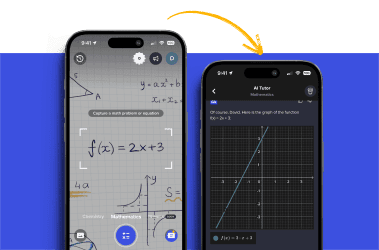


Take a picture of your assignment and use AI tutor.
Expressions and Factorization
1 video
Vieta's Formulas

Natural Numbers
Simplifying Expressions
THE SET OF NATURAL NUMBERS
Natural numbers form the basic set of numbers we use for counting objects and ordering by size. They are often denoted by the symbol ℕ. There are two common definitions for this set:
- ℕ = {1, 2, 3, 4, …} (without 0)
- ℕ₀ = {0, 1, 2, 3, …} (includes 0, sometimes referred to as whole numbers in this context)
The first definition is used more frequently, especially in number theory, while the second includes 0 as a natural number, which is useful in certain mathematical structures. (In many English contexts, "whole numbers" refers to {0, 1, 2, 3, ...} and "natural numbers" refers to {1, 2, 3, ...} or sometimes {0, 1, 2, 3, ...}, so clarity is important).
THE SET OF INTEGERS
The set of integers, denoted by ℤ, includes all natural numbers, their opposites (negative numbers), and the number 0. Thus, the set is defined as: ℤ = {…, -3, -2, -1, 0, 1, 2, 3, …}
Integers allow for all basic arithmetic operations, including subtraction, which is not always possible within the set ℕ (if ℕ excludes 0 and negative numbers). For example, if we subtract 5 from 3, we get -2, which is not a natural number (by the first definition) but is an integer.
PROPERTIES OF NATURAL NUMBERS AND INTEGERS
Both sets have important mathematical properties:
- SUCCESSION: Every natural number has a successor, obtained by adding 1.
- INFINITUDE: Both sets are infinite, as we can always find a new number that follows the existing ones.
- BOUNDEDNESS (FOR NATURAL NUMBERS): All natural numbers are greater than or equal to 1 (or 0 in some definitions). Integers extend infinitely in both positive and negative directions.
- NEUTRAL ELEMENTS (IDENTITY ELEMENTS): The number 0 is the neutral element for addition (a + 0 = a), while 1 is the neutral element for multiplication (a × 1 = a).
EXAMPLES OF BASIC OPERATIONS
Operations on natural numbers and integers follow specific rules:
- ADDITION: 5 + 3 = 8; (-2) + 6 = 4
- SUBTRACTION: 7 – 4 = 3; (-3) – 5 = -8
- MULTIPLICATION: 4 × 3 = 12; (-2) × 3 = -6
- DIVISION: Division is not always possible within the set of integers to yield another integer (e.g., 7 ÷ 2 is not an integer but a fraction/rational number).
CONCLUSION
Natural numbers and integers are fundamental mathematical sets that enable basic computational operations. While natural numbers form the basis for counting, integers expand this set with negative values, allowing for more general mathematical treatment. Their use ranges from basic arithmetic to advanced mathematical concepts.