
Real Numbers
1 chapter
Real numbers are a set of numbers that include rational and irrational numbers. They are used to represent all points on the number line. The set of real numbers is denoted by ℝ.
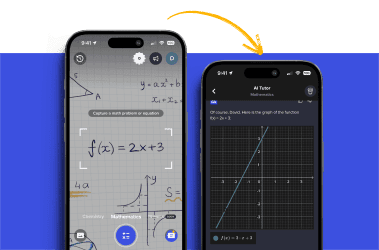


Take a picture of your assignment and use AI tutor.
Square and Cube Root
2 videos
Rules for Calculating with Roots

Simplifying Square Roots (Partial Rooting)
SUBSETS OF REAL NUMBERS
Real numbers can be divided into two main subsets:
- RATIONAL NUMBERS (ℚ): Numbers that can be written as a fraction p/q, where p and q are integers and q ≠ 0 (e.g., 1/2, -3/4, 5 which is 5/1).
- IRRATIONAL NUMBERS: Numbers that cannot be written as a simple fraction and have an infinite, non-repeating decimal representation (e.g., √2, π, e).
PROPERTIES OF REAL NUMBERS
- DENSITY: Between any two distinct real numbers, there is always another real number.
- INFINITY (UNBOUNDEDNESS): The set ℝ is unbounded in both the positive and negative directions.
- CLOSURE: Real numbers are closed under basic arithmetic operations (addition, subtraction, multiplication, and division, except for division by 0).
BASIC OPERATIONS
- ADDITION: 2.5 + 1.3 = 3.8
- SUBTRACTION: 7 – 4.2 = 2.8
- MULTIPLICATION: 1.5 × 3 = 4.5
- DIVISION: 5 ÷ 2 = 2.5
CONCLUSION
Real numbers represent the entire number line and allow for the notation of all possible quantities. Their structure is the foundation of many mathematical fields, including analysis and algebra.