
Sequences
3 chapters
Sequences are mathematical structures composed of a series of elements arranged in a specific order. Each element in a sequence is determined by its position and can follow a specific pattern or rule.
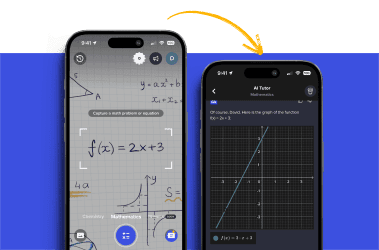


Take a picture of your assignment and use AI tutor.
Introduction to Sequences
3 videos
What is a Sequence?

Decreasing and Increasing Sequences
Is a Sequence Bounded or Unbounded? 1
Arithmetic Sequence
2 videos
What is an Arithmetic Sequence?
Difference and Calculation of the General Term
Geometric Sequence
1 video
What Is a Geometric Sequence?
UNDERSTANDING SEQUENCES IN MATHEMATICS
Sequences are defined as a set of elements that follow a particular pattern or rule. Each element in a sequence is known as a term of the sequence. These are fundamental concepts in various fields of mathematics, including analysis, combinatorics, and number theory.
DEFINITION AND BASIC PROPERTIES OF SEQUENCES
A sequence is a function whose domain is the set of natural numbers (or a subset of natural numbers, like the first 'n' natural numbers for a finite sequence) and whose range is a set of elements. This definition allows sequences to be classified according to their properties, such as:
- FINITE AND INFINITE SEQUENCES: A finite sequence has a specific number of terms, while an infinite sequence has terms that continue indefinitely.
- MONOTONIC SEQUENCES: A sequence that is constantly increasing or decreasing.
- BOUNDED SEQUENCES: A sequence whose terms do not exceed a certain value (or fall below a certain value).
In mathematics, we distinguish between different types of sequences that are important due to their unique properties and applications:
- ARITHMETIC SEQUENCE: In this sequence, the difference between consecutive terms is constant (this constant is called the common difference).
- GEOMETRIC SEQUENCE: Here, the ratio between consecutive terms is constant (this constant is called the common ratio).
- HARMONIC SEQUENCE: The reciprocals of the terms of this sequence form an arithmetic sequence.
- FIBONACCI SEQUENCE: Each term is the sum of the two preceding terms (e.g., 1, 1, 2, 3, 5, 8...).
USES
Sequences play a key role in the development of mathematical theories and techniques. Some important aspects include:
- BASIS FOR THE DEFINITION OF LIMITS AND INFINITY: The limit of a sequence allows for the understanding of the concept of infinity and convergence.
- USE IN SERIES: The sum of the terms of a sequence, known as a series, is fundamental for analyzing and solving various mathematical problems.
- MODELING AND PREDICTION: Sequences enable the modeling of natural phenomena and the prediction of future events in various scientific disciplines.
CONCLUSION
These concepts are basic building blocks for understanding and analyzing mathematical structures and natural phenomena. Their ability to describe patterns and model changes is crucial for the development of theories and solutions in mathematics and other scientific disciplines. Understanding and using sequences thus opens the door to deeper insight into mathematical analysis.