
Derivative by Definition 1
Video explanation
Explanation
WHAT IS THE DERIVATIVE BY DEFINITION?
The derivative by definition is a fundamental concept in differential calculus that measures how the value of a function changes in relation to the change in its variable. This concept is not only the basis for theoretical mathematics but is also crucial for understanding and modeling natural and scientific phenomena.
DEFINITION OF THE DERIVATIVE
The derivative of a function 'f' at a point 'x' is defined as the limit of the ratio of the change in the function, f(x+h) - f(x), to the change 'h' in the variable, as 'h' approaches zero. Mathematically, this is expressed as: f′(x) = lim (as h→0) [f(x+h) – f(x)] / h
MEANING OF THE DERIVATIVE
The derivative allows for a precise analysis of how a function reacts to small changes in its variable. This gives us information about the rate of change of the function, which is useful when investigating its properties, such as extrema (maximums and minimums), intervals of monotonicity (where the function is increasing or decreasing), and the behavior of the function at infinity.
CALCULATION (GENERAL TERM)
Calculating the derivative by definition requires an understanding of limits and the ability to manipulate algebraic expressions. In practical calculations, we often encounter functions such as polynomials, exponential, logarithmic, and trigonometric functions, each requiring a specific approach for calculating the derivative using the definition.
CONCLUSION
The derivative by definition is key to understanding the fundamental concepts of differential calculus and has wide applications in mathematics. Its ability to provide insight into the changes of functions is indispensable in the analysis of mathematical models.
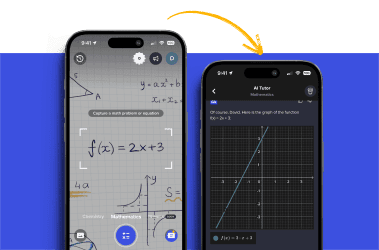


Take a picture of your assignment and use AI tutor.
- Definition of the Derivative
- Stationary Points, Increasing/Decreasing Functions
- Slope of the Tangent and Normal Line
- Derivatives of Other Elementary Functions