
Permutations with Repetition
Video explanation
Explanation
Permutations with repetition are an important concept in combinatorics, the branch of mathematics dealing with counting and arranging elements. Unlike standard permutations where each element in a sequence appears once, permutations with repetition allow identical elements to appear multiple times.
CORE CONCEPT
A permutation is any possible arrangement or sequence of a given set of elements. In permutations with repetition, some elements in the sequence can be identical. For example, with the set of elements A, B, and C, the standard permutations are ABC, ACB, BAC, BCA, CAB, and CBA. However, if repetitions are allowed, we can also have permutations like AAB, BBA, CCA, etc.
The most common type of problem involves arranging a set where some items are indistinguishable, such as the letters in the word "BOOK".
THE FORMULA
The formula for calculating the number of permutations with repetition depends on the total number of elements and the number of times each unique element is repeated. If we have a total of n elements, where the first element is repeated a times, the second element is repeated b times, and so on, the number of distinct permutations is given by: P = n! / (a! * b! * ...) Here, n! (n factorial) is the product of all integers from 1 to n, and a!, b!, etc., are the factorials of the number of repetitions for each distinct element.
EXAMPLES OF PERMUTATIONS WITH REPETITION
- Example with Letters: How many distinct arrangements can be made from the word BALLOON? It has 7 letters in total (n=7). The letter 'L' is repeated twice (a=2) and the letter 'O' is repeated twice (b=2). Number of permutations = 7! / (2! * 2!) = 5040 / (2 * 2) = 1260.
- Example with Numbers: How many distinct numbers can be formed by arranging the digits 1, 1, and 2? There are 3 digits in total (n=3). The digit '1' is repeated twice (a=2). Number of permutations = 3! / 2! = 6 / 2 = 3. (The arrangements are 112, 121, and 211).
PRACTICAL USES AND APPLICATIONS
This concept has wide applicability in mathematics, statistics, computer science, and other fields. It is used to solve problems involving arrangements where some elements can be repeated, such as:
- Coding and Cryptography: In creating and analyzing codes and encryption keys.
- Computer Science: In algorithms for generating and analyzing different combinations of data.
- Statistics: In probability theory to calculate the likelihood of events where repetition is possible.
- Genetics: In analyzing possible genetic combinations.
CONCLUSION
Permutations with repetition are a fundamental concept in combinatorics that allows mathematicians and scientists to accurately calculate the number of possible arrangements in groups where some elements are identical. Understanding this concept is important for students and professionals dealing with mathematics, computer science, statistics, and other related disciplines. These techniques are key to solving complex problems in many scientific and practical applications, from developing software algorithms to understanding complex biological patterns.
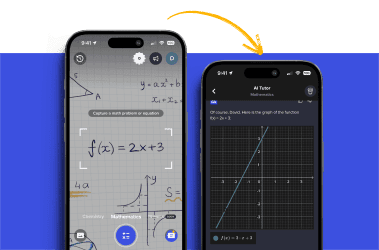


Take a picture of your assignment and use AI tutor.
- The Fundamental Counting Principle
- Permutations
- Variations in Combinatorics
- Combinations